

Choosing the correct application model can affect product success, customer interaction, and business growth. Every company that is looking to develop a digital product has to make a decision regarding browser-based apps or platform-based mobile apps. Many factors can sway that decision, including cost, performance, scalability, ease of maintenance, user requirements, etc. This comparison will help business owners, product managers, and founders make a decision that will eliminate technical constraints on business growth.
Why is the comparison important to your business?
Mobile app use is on the rise across industries. Consumers want fast, safe, and easily navigable experiences regardless of how they access a product or service. The wrong tech choice impacts cost, customer retention, and growth.
Startups will often create web-based MVPs to quickly test product ideas. Larger corporations are often more willing to invest in platform-based mobile apps, as performance and customer experience are major competitive differentiators. Knowing the advantages and disadvantages of either solution will help your business choose the best option.
Choosing between Native App vs Web App depends on business priorities.
Native Apps are best when high performance is crucial, and when integrated device features and offline capability are required.
When cost of development, time to launch, and ease of adjustment are priorities, then Web Apps are the solution.
Often, startups will validate ideas using web-based apps for MVPs and then later create platform-based mobile apps.
A business that attracts a large amount of mobile users typically finds developing a mobile app to be a good investment.
There is no clear winner between the two development approaches. Balancing customer needs, pricing, timelines, and planning for the future provides the context for deciding the best approach.
What is a native app?
A native app is a mobile app developed with the tools and languages of the operating system of the mobile device, such as Android or iOS.
Examples of native apps are WhatsApp, Google Maps, Uber, and Spotify.
Main Advantages
Speed
Seamless app transitions
More secure
Functional without internet connection
Access to device hardware
Integrates directly to OS
Because native apps are developed with OS tools, businesses that want to maximize customer engagement find native apps developed to be the best investment
What is a web app?
A web app is an application that is accessed via a browser. Because of this, a web app does not need to be downloaded from an application marketplace.Users access a web app by clicking a URL via their mobile browser, tablet, or PC.
Examples of web apps are Google Docs, Trello Web, Canva Web, and most SaaS.
Main Advantages
No need to download an app
Faster development
Low cost development
Simple to maintain
Accessible on any device with a browser
Single version for all platforms
For a business that wants to engage users quickly, web apps that are simple to maintain and low cost to develop are great investment apps.
Difference between native and web app solutions
When looking at the various performance and user experience metrics, the distinction between a native and web app is clear.
Here’s what you should know about Native Apps and Web Apps.
Feature
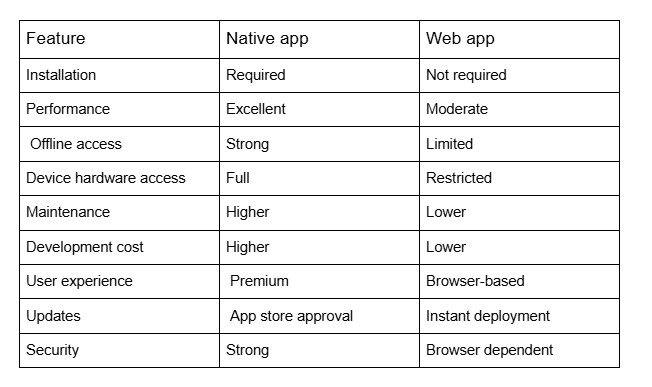
Both Native and Web Apps can lead to successful products, but focusing on what your customer expects will he the biggest selling point.
Performance Comparison
Because of performance concerns, most businesses prefer Native App Development.
Direct communication with device hardware and operating systems leads to faster Native App Development.
Native App Strengths
Quick loading
advanced graphics
responsive scrolling
optimal battery usage
Web App Limitations
Heavy reliance on browser
Limited Hardware
Network delays
Slow rendering
For Apps that require advanced mobile features and real-time communication, Native Development wins every time.
Mobile App User Experience
A polished Mobile App User Experience increases customer loyalty and sales.
Because Native Apps follow Android and iOS Guidelines, User Experiences become more Intuitive.
Native App experience
Offers faster interactions
Supports gestures
Provides easier accessibility
Can be personalized
Integration can be seamless
Web App experience
Instant access
No download barrier
Interface consistency across devices
Web apps and their modern technologies are much improved. However, they still face limitations due to web browser restrictions, which affect their responsiveness when compared to native applications.
App Store vs Web App Distribution
This App Store vs Web App choice impacts customer acquisition, visibility, and how updates are managed.
App Store Benefits
Consumer trust
Brand credibility
App marketplaces support discovery
Payment systems are built in
App Store Drawbacks
Approval processes
Platform restrictions
Revenue sharing
Web App Benefits
Global access
No installation
Fast updates
No approval from marketplaces
Web App Drawbacks
Low discovery
Heavy reliance on advertising
Browser restraints
When choosing a distribution method, businesses should determine how customers will find and use it.
Native App vs Progressive Web App
This Native App vs Progressive Web App choice has grown in importance.
Progressive Web Apps offer the combination of a web browser and features normally found in mobile applications.
Progressive Web App Benefits
Can be made to feel native
Faster development time
Lower costs
Can cache and function offline
Can be made to work on all devices
Native App Benefits
Faster and improved functionality
Integrated security
Better customer interaction
For service-based businesses and startups, PWAs are often the ideal solution.
Comparing React Native and Web Apps
The comparison of React Native and Web Apps primarily considers the advantages of mobile functionality and development efficiency in both frameworks.
By using React Native, companies are able to develop single apps for both the Android and iOS platforms with the benefit of almost native-like performance.
Advantages of Using React Native
Apps developed for both Android and iOS platforms
Cost savings from less code
Reduced costs for maintenance
Vibrant development community
Advantages of Web Apps
Accessible via a browser
Quicker to develop and publish
Less code to manage
Companies that develop apps with a mobile-first approach and want to avoid the overhead of managing separate teams for the development of the Android and iOS apps, prefer to use React Native.
Comparing Development Costs
Application budgets heavily dictate the technology selection.
Costs Associated with Native Development
Android and iOS development
Development and testing resources for each platform
Increased costs for ongoing maintenance
Costs Associated with Web Development
Single codebase for both client and server
Development is quicker
Easier and less expensive to maintain
To validate customer interest and reduce the risk of developing products that do not meet market requirements, many companies decide to build an MVP Development Web App and launch it to users. If the web app gains traction and is successful, they will then invest in developing mobile apps.
Considering Security
When an application collects and processes payments, health care information, personal finance information, or customer accounts, the security of that application becomes an important consideration.
Security Features of Native Apps
Local data is stored securely
Biometric authentication is available
Protection from malicious code and attacks from the operating system
Encrypted communication with a server
Security Features of Web Apps
Updates are done in one central location
Security is managed on the server
Access can be controlled and monitored
It is important to implement security best practices with both technologies.
When should businesses choose a native app?
Native applications are typically the best option for:
High performance
The ability to work offline
High engagement
Scalability
Access to advanced features
ealthcare, fintech, transportation, gaming, and e-commerce all see large benefits from native applications.
Companies focusing on making high-quality, secure, and scalable mobile applications partner with experienced Android app development services.
When should businesses choose a web app?
Web applications are typically the best option for:
Limited budget
Fast entry to market
Wide accessibility
Rapid updates
Validation of the product with the least effort
Common examples are SaaS, customer or employee portals, and MVPs for startups.
Future trends for 2026
Application development will keep evolving quickly.
Artificial intelligence
Expect more and more personalized and predictive experiences, facilitated through automation and driven by AI.
Progressive web apps
PWAs will continue to attract developers as web browsers improve and the cost of development remains low.
Cross-platform development
Expect a continuation of reduced development times and maintenance costs as frameworks like React Native gain popularity.
Security and privacy
Regulatory requirements will expect more secure frameworks and tougher authentication mechanisms.
User experience
There will be a continued focus on fast, simple, and highly personalized experiences, as businesses invest more in this area.
FAQ
Is a Native App Better than a Web App?
App type choice depends on project goals. Native apps win for performance, offline access, and lots of advanced mobile features. Web apps win for faster market delivery and reduced dev resources.
What’s the Difference Between Native and Web App Development?
At the core, the difference between native and web app development is that native apps are built for specific Android or iOS platforms. Web apps are cross-platform and built to run in a web browser.
Which is Better for Performance?
Native app performance is typically the best of all options. This is because, after the initial load, the application interacts directly with the device’s hardware and operating system.
Difference Between App Store and Web App Distribution?
The app store vs web app difference is found in distribution and accessibility. App store apps require the user to download the app. Web apps are accessed directly in a browser.
Do Startups Begin With a Web App?
Startups commonly begin with an MVP development web app because it requires less time and money and provides a means to validate the business and receive feedback.
Is a Progressive Web App a Good Alternative?
The native app vs progressive web app comparison is all about the business goals. PWAs are a better app choice for cost and time. Native apps are better for performance and accessing device hardware.
How does React Native compare with a web app?
The key difference between React Native vs. a web app is mobile functionality. A responsive React Native mobile app is closer to a native mobile experience. A web app can more easily be accessed via a browser across multiple devices.
How do I choose the right development partner?
Look for a Mobile app development company that understands Android, iOS, cross-platform app development, UI/UX design, security, and who can provide support after the app is launched.
Conclusion
The decision in the Native App vs Web App analysis should be based on business goals and not solely on what is trending in technology.
Native apps have the advantage of providing a premium mobile experience that is highly responsive and secure with deep integration on the device. Web apps have the advantage of being the fastest to develop, easiest to maintain and the least costly.
Native apps are common for established businesses to develop for customer engagement and long-term growth, while web apps are most common for the MVP a startup develops to test the market.An effective business application strategy relies on understanding customer needs, budget, desired performance, and how the app may grow in the future. Choosing the right and most appropriate technology allows for business growth and a competitive advantage that is especially needed in 2026 and beyond.
Written by
Shyftr Editorial Team
A team of engineers, designers, and strategists building production-grade software for companies worldwide.


Ready to turn insight into action?
Book a free 30-minute call. We'll listen and share exactly what we'd build.